
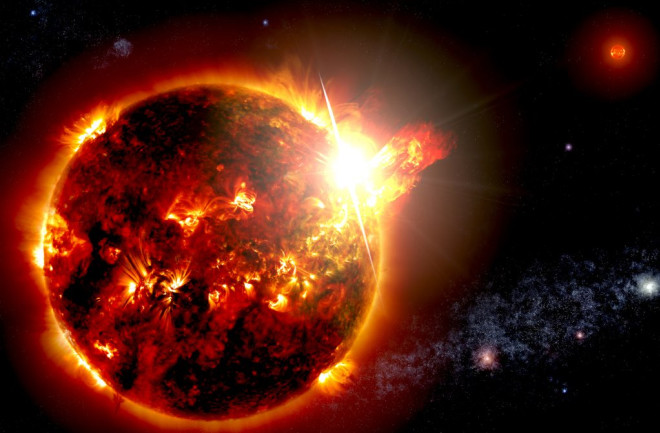
Red dwarfs are pretty cool (literally). They are the smallest star that is classified as a “star.” They are the longest-lived star, and the most common in the galaxy, making up over ⅔ of all the stars in the Milky Way. Let’s learn about these cool, red, and common stars in the universe.
Formation
All stars form the same way, by collecting material in accretion disks. Unfortunately for them, their accretion disks aren’t as big. This can happen for a lot of reasons. For example, a different star could have passed by and ripped material off. Or maybe instead of only one star forming, two could be in a binary orbit and the stars had to share. Or the red dwarf could have simply formed in a non-gassy region.
Whatever the case, the star didn’t get enough material to grow bigger. The size of these celestial beings is between 7 and 50% of the size of the sun. Not much bigger than Jupiter. They are also very dim. It’s impossible to see one in the night sky.
What are they?
Like all stars, red dwarfs fuse hydrogen into helium. But while massive stars have all that helium in their cores, red dwarfs stay convective. That means that the hot material in the core flows to the surface, while the cool material on the surface sinks to the core. This can’t happen with larger stars because they have very massive cores, pulling in all the heavy elements towards them. In red dwarfs, hydrogen and helium constantly mix. That means that they use up their fuel super slowly. When they finally run out of fuel, they don’t expand, like other stars in the main sequence, but sort of “fizz out.” However, since they burn their fuel so slowly, their average expected lifespan is between 1 and 10 trillion years! About 700 times more than the age of the current universe.
The term “red dwarf” does not refer to a single kind of star. It is frequently applied to the coolest objects, including K and M dwarfs — which are true stars — and brown dwarfs, often referred to as “failed stars” because they do not sustain hydrogen fusion in their cores.
The smallest star in the universe is also a red dwarf.
A Future Home for Humanity
Our sun will die one day. Sure, it’ll happen in 5 billion years, but it will still happen. If we survive that long, we’ll eventually have to look for a future home. The Kepler telescope found that at least half of all red dwarfs host habitable rocky planets between half and four times the mass of Earth. Many are in the habitable zone – the zone where the temperature is perfect so that water doesn’t freeze or boil.
Unfortunately, since red dwarfs are much cooler than our sun, the habitable zone is much closer to the star. Probably as close as Mercury. That brings a whole bunch of other problems. For example, a planet that is close to the star would be tidally locked, meaning that one side of the planet always faces the star, and the other side always faces away. That would make one side of the planet extremely hot, and the other side freezing. However, if the planet had a large enough ocean, it could distribute the heat around the entire planet.
There would also be tidal forces. Tidal forces would be bad because the forces can squeeze the planet and heat it up, boiling the water over time.
Another problem is energy output. The star could be covered in starspots that dim the brightness of the star by up to forty percent for months, which could freeze any oceans that a planet might have. At other times, they can emit powerful solar flares, doubling their brightness in minutes, stripping away a planet’s atmosphere until there is nothing left but a hunk of rock.
On the other hand, because red dwarfs have long life spans, things can live on planets for trillions of years. A red dwarf, with moderate levels of activity, could be an amazing place that hosts life.
Life on Earth has existed for about four billion years, and we have another billion years before the sun gets too hot and burns the Earth to a crisp. We will either die out or leave Earth and look for a new home. We could potentially build a civilization that survives for trillions of years around a red dwarf.
If you look at all the red dwarfs in the Milky Way, about 5% have habitable planets that look like Earth. That would be more than four billion! But the habitable planets don’t have to be earth-like planets. They could be a moon around a gas giant. There are an estimated 60 billion habitable planets around red dwarfs. And that’s in the Milky Way alone. But nothing can live forever, even red dwarfs.
Death
When a red dwarf runs out of fuel, it will die. And it’s pretty boring compared to other types of star death. As the star’s hydrogen runs out, it becomes a blue dwarf, burning out completely. After its fuel is spent, it turns into a white dwarf, about the size of the Earth, packed very tightly and made of mostly helium-4 nuclei.
Having no source of energy, it will slowly dim and eventually turn into a black dwarf, where it will stay until the end of time.
Conclusion
All in all, there are billions of habitable planets in the Milky Way around red dwarfs, red dwarfs are very cool, and these stars might just be the saviour of humanity. They have an amazing history, and might be one of the longest living things in the universe!
Recent Comments