
This week, I had a science test! It was very interesting because it was only 15 questions, but still pretty hard, and it was about Biology! I also worked on my Unit 2 Inquiry Project for science. And I did the unit 11 Send-in Assignment for math! It was really fun because it was about data and averages.


Hi Ethan,
It sounds like you had an interesting week of math, science, and computers.
The history of the atom is fascinating isn’t it! I enjoyed reading the excerpt of what you wrote about it. I find it very interesting to read about the history of all sorts of concepts and how they gradually become increasingly accurate as new discoveries are made. I wonder what future discoveries will be made about the atom that will further refine our understanding of it! Up through Bohr the key historical figures in atomic science were men, with the notable exception of Marie Curie and her work on radiation, but just a little further into the 20th century (where understanding the atom gets a lot more complicated) several of the most important atomic scientists and particle physicists were women! Middle/high school materials usually only mention a couple men atomic scientists after Bohr though, and the amazing contributions of women aren’t widely known. For example Austrian-Swedish physicist Lise Meitner was the first to figure out and describe nuclear fission (the Nobel Prize for nuclear fission was given only to her collaborator Otto Hahn, although she was nominated for the Nobel Prize in both chemistry and physics many times over her lifetime); Chinese-American physicist Chien-Shiung Wu was the first to experimentally verify quantum entanglement and also did the foundational experiments on and was the world’s leading authority on beta decay, and most importantly, experimentally disproved conservation of parity, upending a widely-held theory in particle physics and setting the stage for the development for most subsequent theories and discoveries in particle physics (the Nobel Prize for disproving parity went only to her male colleagues who had written a paper about the theory, to the outrage of them and other leading particle physicists who believed she should have won); and German-American physicist Maria Goeppert Mayer who came up with the mathematical model for the atomic shell model of the nucleus (and she did win a Nobel Prize!).
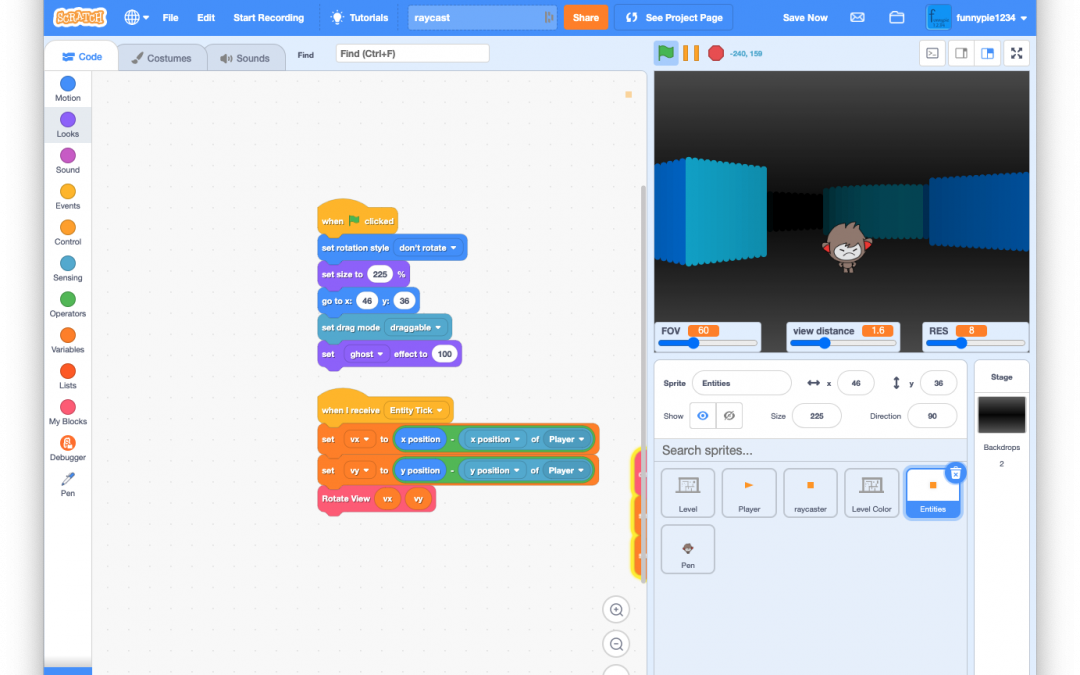
Raycasting sounds interesting! Can you tell me more about it? I’m also curious about doing it in other languages. I don’t think I’ve heard you mention anything about a second language this year — are there any languages that you work with a little, or that you are interested in learning more about?
I think making a prime number checker sounds like fun! I’d love to hear more about how you check the numbers — what kinds of things are you going to program it to look for to avoid having to brute-force check through all the potential divisors of each number? I hope you’re able to get it to work.
Ah, tax is a very important one, but one that many people find overwhelming when they’re learning about it. It’s great you’re familiarizing yourself with it early so that you’ll know how to understand and do tax calculations of your own as an adult. How are you finding doing the calculations lately, and is there anything you’re still finding hard to follow?
Thank you for sharing the wormhole writing. Wormholes are amazing to think about!
I’m glad you’re pleased with the biology quiz. What kinds of questions did it have?
Thank you for your Observing for Learning.
Best,
Shannon
Recent Comments